Companion Handbook · Read this first
Understanding Local Government
Who decides what in local land-use government, and how a file moves between them.

Before They Build
Understanding Local Government
A Neighborhood Action Guide
Companion Handbook · Civic Handbook · Vol. I
Vol. I · Edition One · Generated September 18, 2026 · Private to this device · Not legal advice.
© 2026 Before They Build™. All rights reserved. Educational re-use permitted; see beforetheybuild.com/permissions.
Preface
Why this handbook comes first
Most of the questions neighbors ask — "who do I call?", "who decides this?", "can I appeal it?" — are really one question: which room is this file in? This handbook names the rooms.
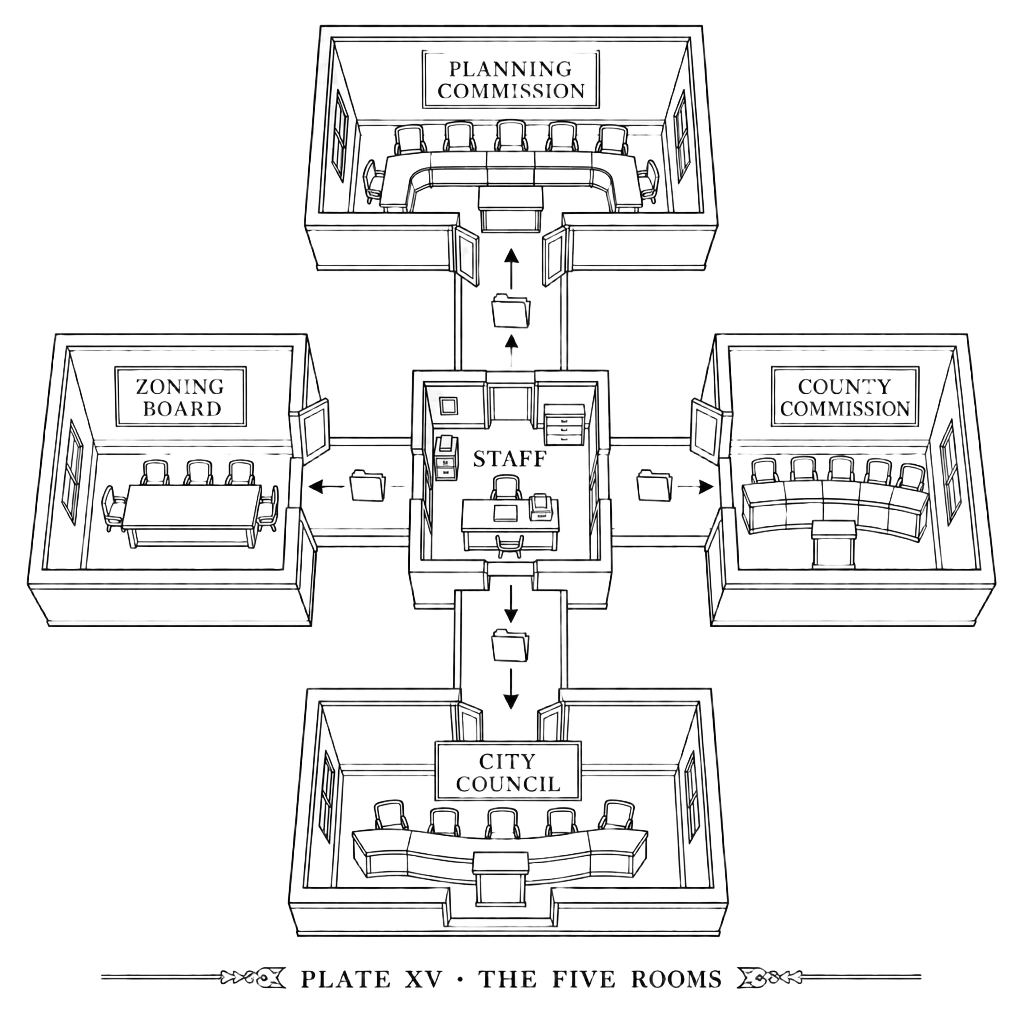
Local land-use decisions move between five rooms: Planning Commission, Zoning Board, County Commission, City Council, and Staff. Staff sits in the middle. Files come into Staff, get analyzed, then move outward to a body for a decision. Knowing which room a file is in tells you who to talk to, what to read, and when to show up.
The five rooms
At a glance
- Planning Commission. Advisory body of appointed citizens. Recommends on rezonings, comprehensive-plan amendments, and major site plans.
- Zoning Board (BZA). Quasi-judicial body. Hears , , and appeals from staff zoning decisions.
- County Commission / Board of Supervisors. Elected. Final say on county rezonings, budget, and major capital projects.
- City Council. Elected. Final say inside city limits on rezonings, ordinances, and budget.
- Staff. Professional planners, engineers, and lawyers. They write the the bodies vote on.
The most important thing on this page
Staff is not your opponent
Staff has read the file. Staff knows the ordinance. Staff usually wants the project to comply, not to be blocked. A polite, specific email to a planner will outperform a passionate speech to a council member nine times out of ten — because staff can change conditions before the vote, and council can only vote yes or no on what staff has drafted.
Related on this site
Executive Summary
Five rooms decide most of what gets built. Staff sits in the middle and prepares every file. Know which room a file is in and you know who to ask, what to read, and when to show up.
The five rooms
- Planning Commission — advisory, appointed.
- Zoning Board (BZA) — quasi-judicial, appointed.
- County Commission / Board of Supervisors — elected.
- City Council — elected.
- Staff — professional, full-time, writes the reports.
§1 — The Five Rooms
Each room has a different role, a different membership, and a different rhythm.
Planning Commission
Appointed citizens who advise the elected body. They hold hearings on rezonings and major plans, then vote a recommendation up. They are usually the first hearing the public attends.
Zoning Board (BZA)
Sometimes called the Board of Zoning Appeals. Quasi-judicial — they apply legal criteria and their decision is appealable to court rather than to the council. Hears variances, special-use permits, and appeals from staff zoning interpretations.
County Commission / Board of Supervisors
Elected. The final decision-maker on county rezonings, ordinance changes, capital projects, and the budget that funds inspections and enforcement.
City Council
Elected. Same role inside city limits. Many regions have both — read the application to see which body the file is going to.
Staff
Planners, engineers, attorneys, and inspectors. Full-time professionals. They write the staff reports the bodies vote on, draft the conditions of approval, and answer the phone.
§2 — Who Decides What
Match the decision to the room. The matrix is the same in most jurisdictions; the names sometimes change.
| Decision | Who decides | Appeal to |
|---|---|---|
| Building permit (by-right) | Staff | BZA |
| Site plan (administrative) | Staff | BZA |
| Variance | BZA | Court |
| Special-use permit | BZA or elected body | Court |
| Conditional use | Planning Commission → elected body | Court |
| Rezoning | Planning Commission recommends → elected body decides | Court |
| Comprehensive plan amendment | Planning Commission → elected body | Court |
| Subdivision (major) | Planning Commission or elected body | Court |
| Code enforcement | Staff | Magistrate / BZA |
§3 — Staff vs Elected
A file is shaped by staff and decided by a body. Most negotiation happens in the staff phase.
How a file actually moves
- Applicant files.
- Staff reviews for completeness, then for compliance.
- Staff drafts conditions of approval.
- Staff posts a report ~10 days before the hearing.
- Body hears the case in public, votes.
- Permit issues against the approved plan plus conditions.
The conditions of approval in step 3 are usually where neighbor input has the most leverage. Once the body votes in step 5, the conditions are essentially fixed.
§4 — The Meeting Calendar
Local government runs on a monthly rhythm. Learn the rhythm and the file stops surprising you.
- Most planning commissions meet twice a month.
- Most BZAs meet once a month.
- Elected bodies meet twice a month — once "work session," once "voting."
- Agenda-posting schedules vary locally. Check the meeting body's official agenda page or ask the clerk when materials are expected.
- Ask the clerk for the locally applicable written-comment cutoff.
How to read an agenda packet
- Open the agenda first. Find your agenda item by number.
- Jump to the staff report for that item — start with the recommendation.
- Read the proposed conditions of approval.
- Skim the application narrative.
- Look at submitted plans last. Plans without context are noise.
§5 — Where Federal & State Touch Local
Local government has the most contact with you, but it is not the whole picture.
- Army Corps of Engineers — jurisdictional wetlands, "waters of the United States" permits.
- EPA — federal environmental compliance and enforcement (ECHO database).
- State DEP / DEQ — water-quality, air permits, contaminated sites.
- FEMA — flood maps and floodplain rules adopted into local code.
- State DOT — driveway permits onto state-maintained roads; traffic studies.
A local approval does not override these agencies' jurisdiction. If a project needs an Army Corps permit, the local approval is conditional on it even when the local ordinance does not say so.
Worked Example — Where does a rezoning actually get decided?
123 Example Road, Anytown — Application RZ-2026-014.
- Filed with Staff (Planning Department).
- Staff prepares a report, drafts five conditions of approval.
- Planning Commission holds a hearing, votes a recommendation.
- County Commission (or City Council) holds the second hearing, takes the binding vote.
- If denied, applicant may refile after a waiting period.
- If approved, building permits issue against the approved zoning and conditions — back to Staff.
The neighbor's leverage is highest at step 2 (shaping conditions with Staff) and step 3 (testimony to the Planning Commission). Showing up only at step 4 leaves most of the levers behind.
How to Address a Body
Use the room's own form of address. It matters less than your evidence does, but it earns goodwill.
- Planning Commission. "Mr. / Madam Chair, members of the Commission…"
- Zoning Board. "Mr. / Madam Chair, members of the Board…"
- County Commission / Board of Supervisors. "Mr. / Madam Chair, members of the Board…"
- City Council. "Mr. / Madam Mayor, members of Council…"
- Staff (by email). "Dear [Title] [Name]," — use Mr., Ms., Director, or AICP if a planner.
Speaking limits and sign-up procedures are set locally. Check the agenda or ask the clerk, prepare a brief version, and be ready to stop promptly.
Understanding Local Government · What success looks like
What success looks like
You are done enough to move forward when you can check every box below.
- I can name the five rooms (Planning Commission, Zoning Board, County, City, Staff).
- For my issue, I know which room makes the binding decision.
- I know whether my decision-makers are appointed or elected.
- I have the meeting calendar of the room I need to be in.
- I know how to address that body in writing and at the lectern.
If every box is checked, you are no longer guessing — you are reading the right room.
What Success Looks Like
You are done enough to move forward when you can check every box.
- I can name the five rooms (Planning Commission, Zoning Board, County, City, Staff).
- For my issue, I know which room makes the binding decision.
- I know whether my decision-makers are appointed or elected.
- I have the meeting calendar of the room I need to be in.
- I know how to address that body in writing and at the lectern.
If every box is checked, you are no longer guessing — you are reading the right room.
Understanding Local Government · Read next
Read next
Where readers usually go from here. Pick one — they are short.
- The Public Hearing Handbook →Once you know which room, walk into it ready to be heard.
- The Rezoning Handbook →The most common reason readers end up in a planning room.
- Research a Project →The six-step method that feeds every public comment.
- Who Handles What? →Match an issue to the agency or board that actually decides it.
Read Next
Where readers usually go from here. All four are companion handbooks or tools on Before They Build.
- The Public Hearing Handbook — Once you know which room, walk into it ready to be heard.
beforetheybuild.com/handbooks/public-hearing - The Rezoning Handbook — The most common reason readers end up in a planning room.
beforetheybuild.com/handbooks/rezoning - Research a Project — The six-step method that feeds every public comment.
beforetheybuild.com/handbooks/research-a-project - Who Handles What? — Match an issue to the agency or board that actually decides it.
beforetheybuild.com/resources/who-handles-what
Before They Build
Civic Handbook · Vol. I · Edition One
Understanding Local Government Handbook · generated September 18, 2026
Prepared by Before They Build Editorial Team · Community Record Series
beforetheybuild.com/reports/community-guide
Printed September 18, 2026 · Reference ID ------
Private to this device. General information only — not legal advice. Confirm details with your local authority.
© 2026 Before They Build™. Educational use permitted. Not legal advice. Reprint or commercial use: beforetheybuild.com/permissions
Free during Public Beta · Suggested Support $2–3 · beforetheybuild.com/support